

Understanding Mutable and Immutable Objects in Python
Search for a command to run...
No comments yet. Be the first to comment.
If you’re building modern web applications, chances are you’ve needed a simple backend for tasks like storing form submissions, feedback requests, or lightweight data logs. Instead of spinning up a server or managing databases, what if you could just...

Real-time applications, such as chat apps, require instant data exchange between clients and servers. In this guide, we'll walk through integrating Socket.io with Next.js (App Router) to build a real-time chat application. 🚀 Why Use Socket.io with ...

Managing global state in a Next.js application can be tricky, but Redux Toolkit (RTK) makes it easier by reducing boilerplate and improving performance. In this guide, we’ll walk through integrating Redux Toolkit with Next.js to efficiently manage ap...

Firebase is a powerful backend-as-a-service platform that offers authentication, real-time databases, and hosting. Integrating Firebase with a Next.js application allows you to build scalable and serverless web applications with ease. Why Use Fireba...
Optimization in Next.js App
Have you ever wondered why changing the value of one variable affects another variable in some cases but not in others? This phenomenon is related to the concepts of mutable and immutable objects in Python. Let's explore this with an example:
Consider the scenario where we have two variables x and y, both initially set to 7. When we assign y = x, both x and y refer to the same object in memory, which is the integer 7. Therefore, if we print the values of x and y, we'll see 7 for both:
x = 7
y = x

print(x)  # Output: 7
print(y)  # Output: 7
Now, let's say we update the value of x to 8:
x = 8

print(x)  # Output: 8
print(y)  # Output: 7
Surprisingly, even though we only changed the value of x, the value of y remains 7. This behavior might seem confusing at first glance, but it's crucial to understand the difference between mutable and immutable objects in Python.

In Python, every object occupies some space in memory. When we create a variable and assign it a value, Python allocates memory for that value and stores a reference to the memory location where the value is stored.
In our example, when we initially set x = 7, Python allocates memory for the integer 7 and stores it at a certain memory address. Both x and y then reference this memory address.
When we update the value of x to 8, Python creates a new integer object 8 and allocates memory for it at a different memory address. The reference of x is then updated to point to this new memory address, while y still maintains its reference to the original memory address containing 7.

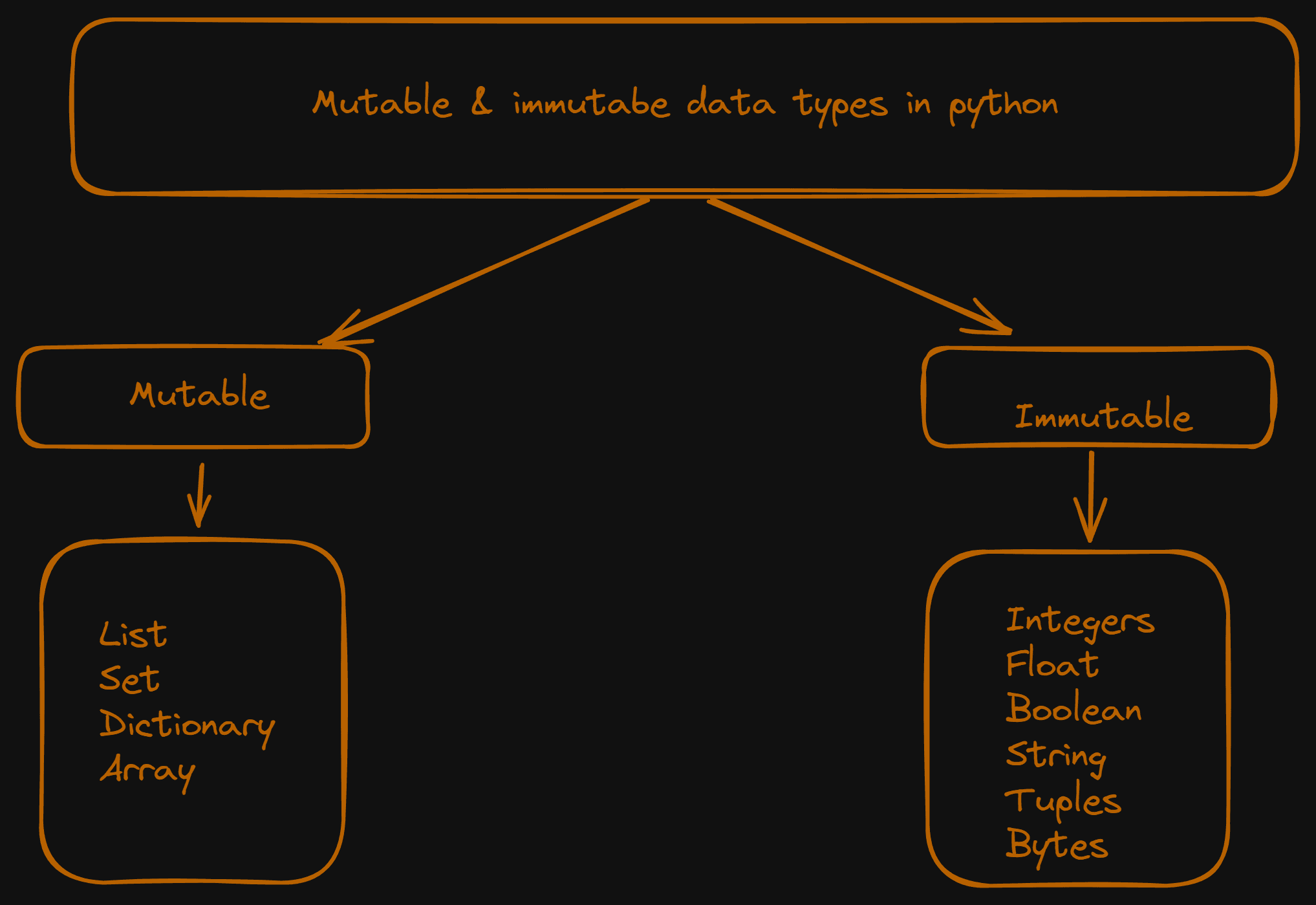
In Python, objects are classified into two categories: mutable and immutable.
Mutable Objects: These are objects whose state can be modified after creation. Examples include lists, dictionaries, and sets.
Immutable Objects: These are objects whose state cannot be modified after creation. Examples include integers, floats, strings, and tuples.
In our example, integers are immutable objects. When we assign y = x, both x and y refer to the same integer object 7. However, when we update the value of x to 8, Python creates a new integer object 8 and updates the reference of x to point to this new object. Since y still points to the original object 7, its value remains unchanged.
Understanding the distinction between mutable and immutable objects is essential for writing efficient and bug-free Python code. Remember, when working with mutable objects, changes to one variable can affect other variables that reference the same object. On the other hand, changes to immutable objects create new objects, leaving existing references unchanged.
By mastering these concepts, you'll be better equipped to harness the full power of Python in your projects! Happy coding!
#ChaiCode #Python #Immutable #Mutable